Beet and Leek Coriander Braise
MODERN KITCHENS · 008 / 100
Roman · Roman Mediterranean · Roman imperial tradition; surviving compilation approximately 4th–5th centuries CE
Evidence: adapted surviving recipe. The historical evidence and modern cooking choices are distinguished below.
A beet can contribute earthy sweetness without becoming a heavy purée. Apicius’s recipe 97 associates beets and leeks with coriander and cumin, although its transmitted wording and sweet-wine interpretation invite caution. This modern braise uses supermarket beetroot and a little grape juice; those choices make the dish accessible rather than resolving every textual uncertainty.
Beetroot and leafy beet terms are not always straightforward across ancient and modern usage. We therefore state the root choice explicitly. Small cubes cook at a reasonable speed and pick up the softened leek flavour. Wear an apron and use a board that can tolerate staining. The saucepan should hold the pieces in a shallow, even layer.
The juice gives the sauce a little sweetness, while a final splash of vinegar sharpens it. Add the vinegar after the roots soften so that the flavour is easy to adjust. Consult the edition notes with the primary passage instead of treating the translation as a fully specified modern instruction. Neither the root variety nor our cooking time comes from an ancient kitchen record.
Serve the beets warm with grain or a plain roast, keeping a few spoonfuls of liquid in the dish. They should be tender enough for a knife to slide through while the cubes remain visible. If the sauce reduces too early, add water and cover again. The aim is a manageable vegetable braise with a documented flavour connection, not a reconstructed medical treatment or preservation method.
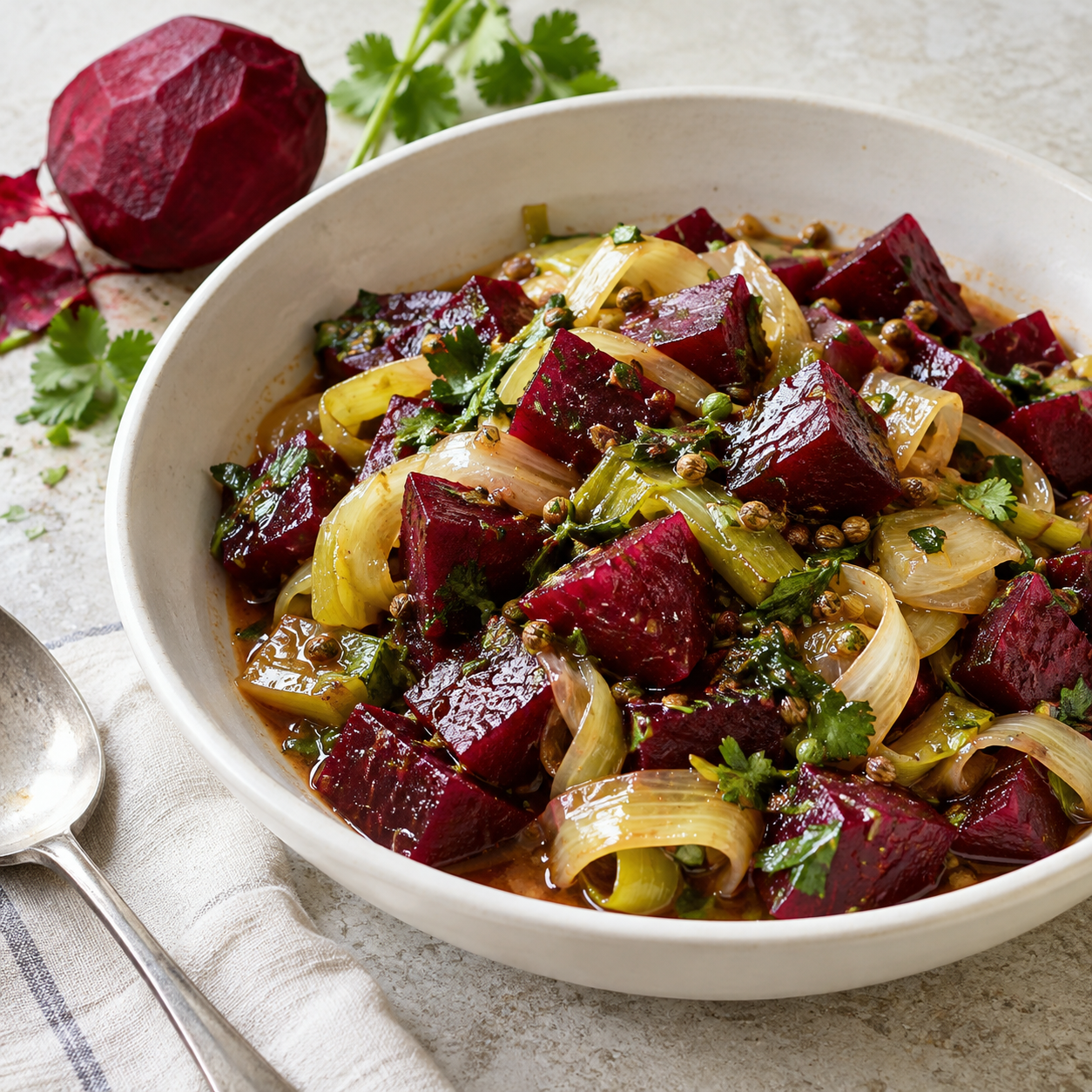
Beet and Leek Coriander Braise
Serves 4 · Preparation 15 min · Cooking 45 min
A modern adaptation for home cooking. Times are approximate.
Ingredients
- 500 g raw beetroot, peeled and cut into 1.5 cm cubes
- 200 g leek, washed and sliced
- 20 ml (4 tsp) olive oil
- 250 ml water
- 100 ml unsweetened grape juice
- 2.5 ml (½ tsp) ground coriander
- 2.5 ml (½ tsp) ground cumin
- 10 ml (2 tsp) red-wine vinegar
- 1.25 ml (¼ tsp) salt
Method
- Soften leek in oil in a saucepan over medium-low heat for 5 minutes.
- Add beetroot, water, juice, spices and salt. Cover and simmer 25–35 minutes until a knife slides easily through a cube. Add water if the pan dries.
- Uncover and reduce liquid for 3–5 minutes if needed. Stir in vinegar, taste and serve.
Substitutions and adjustments
- Vacuum-packed cooked beetroot can be used; reduce liquid to 150 ml and simmer only 10 minutes.
- Red or white grape juice works; it replaces sweet wine deliberately.
Historical choices: Apicius 97 links beet, leek, coriander and cumin. Root beet, grape juice and the modern braising method are explicit interpretive choices.
Troubleshooting: Hard cubes: add 50 ml water, cover and cook another 10 minutes. Sweet sauce: add vinegar in 5 ml increments.
Storage and reheating: Cool in shallow containers and refrigerate within 2 hours. Keep up to 3 days; reheat leftovers to 74°C/165°F until steaming throughout.
Kitchen note: Refrigerate perishable food within 2 hours; keep at 4°C/40°F or below.
Sources and further reading
- Apicius, Book 3, recipe 97 (Vehling numbering). Inspected surviving recipe and editorial notes. Apicius 97 links beet, leek, coriander and cumin. Root beet, grape juice and the modern braising method are explicit interpretive choices. Quantities and modern timetable are our own; translation contains editorial additions.
- LacusCurtius: edition and translation notes. Explains limitations and bracketed additions of the 1936 Vehling translation; not proof of an exact ancient appearance.
- NYAM collections announcement via CHSTM. Institutional account places the recipe collection in the fourth and fifth centuries; individual material may be earlier.
Browse Ancient Recipes for Modern Kitchens · More creative work at Incoprea


Comments
Post a Comment