Poached White-Fish Dumplings in Savoury Broth
MODERN KITCHENS · 030 / 100
Roman · Roman Mediterranean · Roman imperial tradition; surviving compilation approximately 4th–5th centuries CE
Evidence: historically informed adaptation. The historical evidence and modern cooking choices are distinguished below.
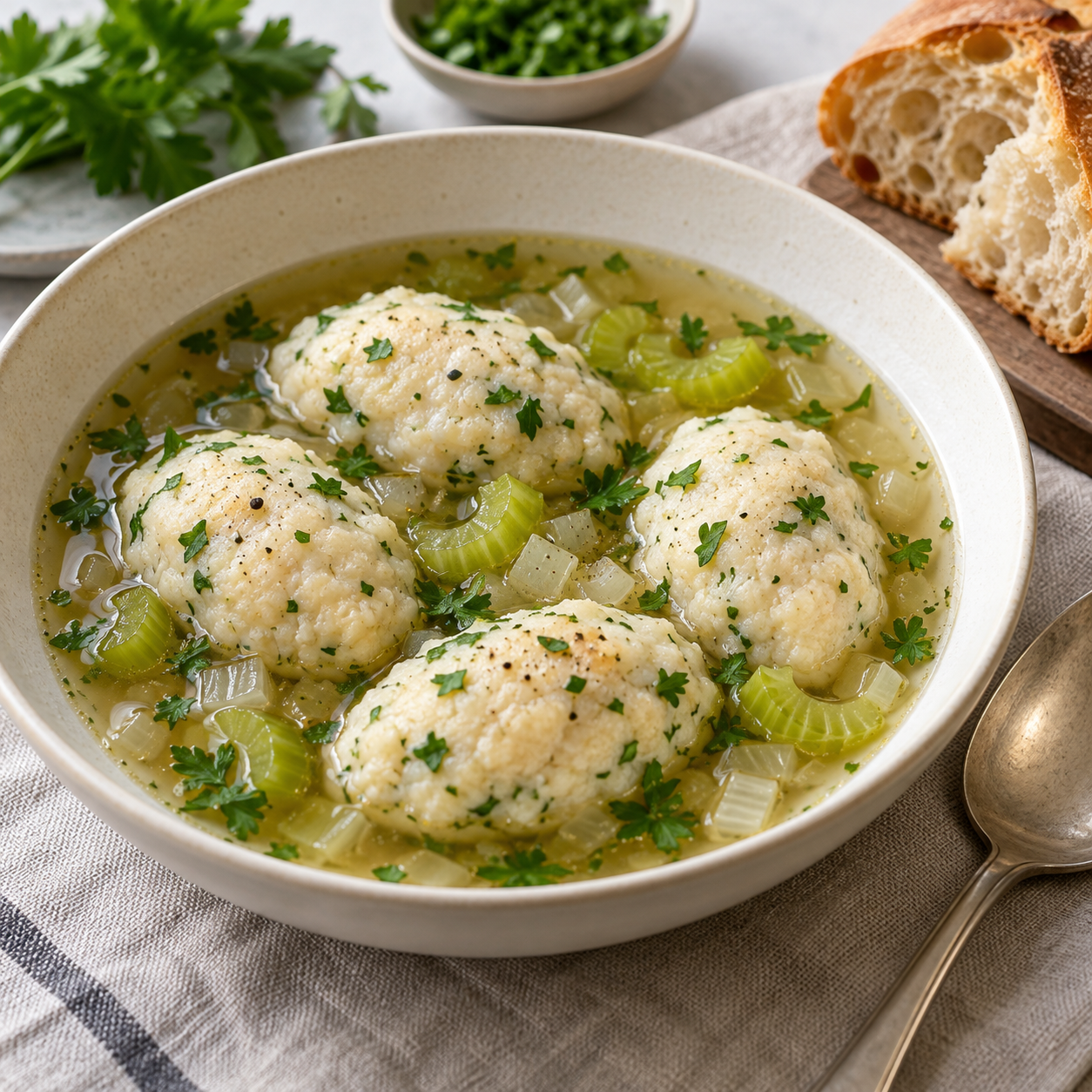
A broth can carry a delicate fish dumpling without a fried crust. Apicius 42 and 49 describe cuttlefish forcemeat and dumplings cooked in savoury liquid. This adaptation brings those methods together with boneless supermarket white fish. Egg and breadcrumbs are measured modern binders; the final bowl is an interpretation rather than a claim that the two passages form one exact ancient recipe.
Keep the fish cold before chopping and use a small food processor or a sharp knife to make a fine mince. Brief processing avoids warming it unnecessarily. The mixture should hold a spooned shape but remain softer than a meatball. A short refrigerated rest lets crumbs absorb moisture and makes the dumplings easier to form.
Commercial fish sauce gives the broth a controlled savoury note, and celery with parsley supplies accessible aromatics. The edition notes are useful because the English translation offers interpretations of both forcemeat and liquamen. Our diluted sauce should not be presented as the precise composition of an ancient fermented product.
Poach at a gentle simmer so the dumplings do not break apart. Two wet spoons make small ovals without special moulds. The centre must be cooked safely, but a rolling boil can toughen the outside before that happens. Serve in shallow bowls with a little broth and plain bread. This method is deliberately distinct from a fried fish cake: it yields tender pale dumplings and a sip of liquid.
Poached White-Fish Dumplings in Savoury Broth
Serves 4 · Preparation 20 min · Cooking 30 min · 15 minutes refrigerated rest
A modern adaptation for home cooking. Times are approximate.
Ingredients
- 500 g boneless white-fish fillets, such as cod, hake or tilapia
- 1 large egg
- 40 g dry breadcrumbs
- 10 g parsley, finely chopped
- 1.25 ml (¼ tsp) black pepper
- 1.25 ml (¼ tsp) salt
- 900 ml water
- 15 ml (1 tbsp) commercial fish sauce
- 100 g celery, thinly sliced
- 50 g onion, finely chopped
Method
- Keep fish cold and check for bones. Finely chop or briefly process fish, then mix with egg, crumbs, parsley, pepper and salt. Refrigerate 15 minutes.
- Simmer water, fish sauce, celery and onion for 10 minutes.
- Using 2 wet spoons, form about 16 small oval dumplings. Lower them into gently simmering broth, in 2 batches if needed.
- Poach 6–9 minutes without a hard boil until each centre reaches 74°C/165°F, a conservative endpoint for this fish-egg mixture. Serve 4 dumplings per bowl with broth.
Substitutions and adjustments
- Use¼ tsp additional salt instead of fish sauce; taste the broth.
- Fine oat crumbs replace breadcrumbs as a modern binder.
Historical choices: Apicius 42 supplies cuttlefish forcemeat and 49 poached dumplings. Combining passages, binder quantities and white-fish cut are modern interpretation.
Troubleshooting: Dumplings breaking: chill the mixture longer, keep the broth below a hard boil and test one dumpling first.
Storage and reheating: Cool in shallow containers and refrigerate within 2 hours. Keep up to 3 days; reheat leftovers to 74°C/165°F until steaming throughout.
Kitchen note: Keep minced fish refrigerated and cook this mixed fish-egg dish to 74°C/165°F. Contains fish, egg and wheat.
Sources and further reading
- Apicius, Book 2, recipe 42 and 49 (Vehling numbering). Inspected surviving recipe and editorial notes. Apicius 42 supplies fish forcemeat and 49 poached dumplings. Combining passages, binder quantities and white-fish cut are modern interpretation. Quantities and modern timetable are our own; translation contains editorial additions.
- LacusCurtius: edition and translation notes. Explains limitations and bracketed additions of the 1936 Vehling translation; not proof of an exact ancient appearance.
- NYAM collections announcement via CHSTM. Institutional account places the recipe collection in the fourth and fifth centuries; individual material may be earlier.
Browse Ancient Recipes for Modern Kitchens · More creative work at Incoprea


Comments
Post a Comment