Milk-Rice: A Textual Idea, a Modern Pudding
MODERN KITCHENS · 077 / 100
Early Buddhist and classical Sanskrit food traditions · Northern Indian subcontinent · first millennium BCE–c. 600 CE
Evidence: historically informed adaptation. The historical evidence and modern cooking choices are distinguished below.
Milk-rice has a textual history as well as a comforting modern texture. An early translation of the Suśruta Saṃhitā describes payasa as rice cooked with milk and sugar. The Sujata offering tradition gives milk-rice a place in Buddhist narrative.
These are layered literary traditions, not a securely dated kitchen notebook with our quantities. We use them to introduce a first-millennium food idea and do not treat a story about an offering as proof of one exact preparation. No historical medicinal claims from the medical text become advice here. The recipe is a measured, present-day pudding inspired by the described rice-and-milk combination.
Ordinary short-grain rice releases starch slowly into pasteurized milk. Keep the heat low once it begins to simmer, and stir along the bottom so the milk does not scorch. Sugar goes in near the end, after the grains are soft. The warm pudding should be looser than you expect, because it thickens as it stands and cools.
Serve small portions plain, without a long list of expensive spices or nuts. A spoonful of water or milk restores leftover pudding's softness during reheating. Dairy-free milk makes an accessible modern variation but changes the ingredient connection in the historical account. The surviving descriptions support a broad dish family; our pan, timing, sweetness and convenient products give it a workable contemporary form.
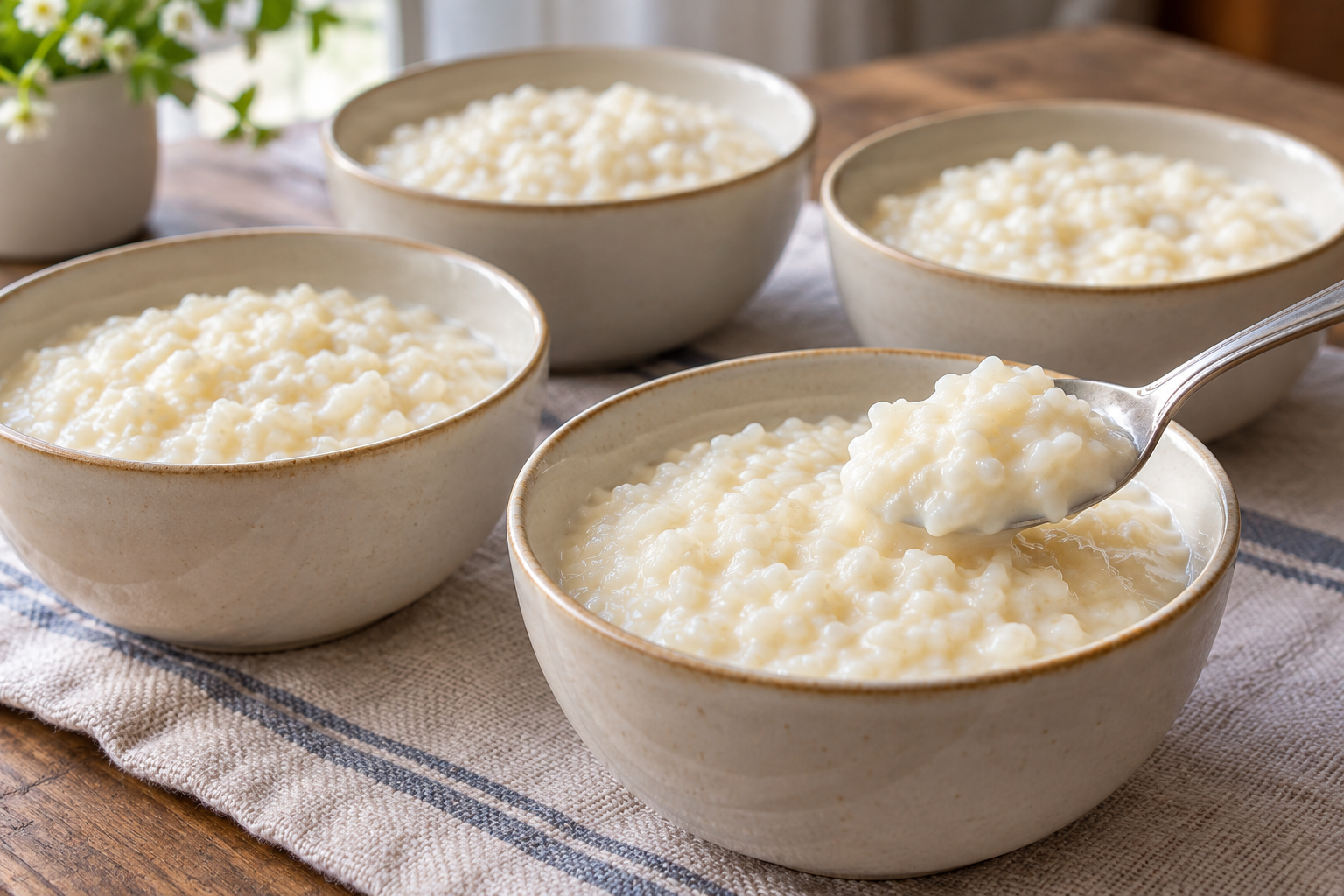
Simple milk-rice pudding
Serves 4 · Preparation 10 min · Cooking 40 min · 5 minutes resting
A modern adaptation for home cooking. Times are approximate.
Ingredients
- 100 g white short-grain pudding rice
- 850 ml pasteurized whole milk
- 150 ml water
- 35 g sugar (about 3 tablespoons)
- 1 g salt
Method
- Put rice, milk, water and salt in a heavy saucepan. Heat gently, stirring, until just simmering.
- Cook on low heat, uncovered, 30–40 minutes. Stir every few minutes and more often near the end, scraping the bottom.
- When rice is tender and liquid creamy, add sugar and stir 2 minutes. Add a little hot water if it is too thick.
- Rest 5 minutes and serve warm. For cold service, cool promptly in shallow containers before refrigerating.
Substitutions and adjustments
- Use lactose-free pasteurized milk with the same method.
- Unsweetened oat milk is a modern dairy-free substitution; flavor and historical ingredient connection differ.
Historical choices: Early literary traditions describe milk-rice; exact dating, measures and this contemporary pudding method are not recovered.
Troubleshooting: Scorching means heat is too high. Transfer unburned pudding to a clean pan without scraping the burned base.
Storage and reheating: Cool within 1 hour; refrigerate up to 1 day. Reheat once to 74°C with a little milk.
Kitchen note: Use pasteurized milk. Cool rice promptly, ideally within 1 hour, and refrigerate at 4°C or colder.
Sources and further reading
- Suśruta Saṃhitā, Sutrasthana 46, early public-domain English translation. Scanned primary-text translation describes payasa as rice cooked with milk and sugar; no medicinal claims are carried into the recipe, and no quantities survive here.
- Indira Gandhi National Centre for the Arts, Sujata. Government cultural institution recounts the Buddhist milk-rice offering tradition and names textual references; a narrative is not evidence of an exact household recipe.
Browse Ancient Recipes for Modern Kitchens · More creative work at Incoprea


Comments
Post a Comment