Everyday Segmented Wheat Loaf
MODERN KITCHENS · 003 / 100
Roman · Pompeii, Roman Italy · Shape inspired by bread preserved in 79 CE
Evidence: archaeological reconstruction. The historical evidence and modern cooking choices are distinguished below.
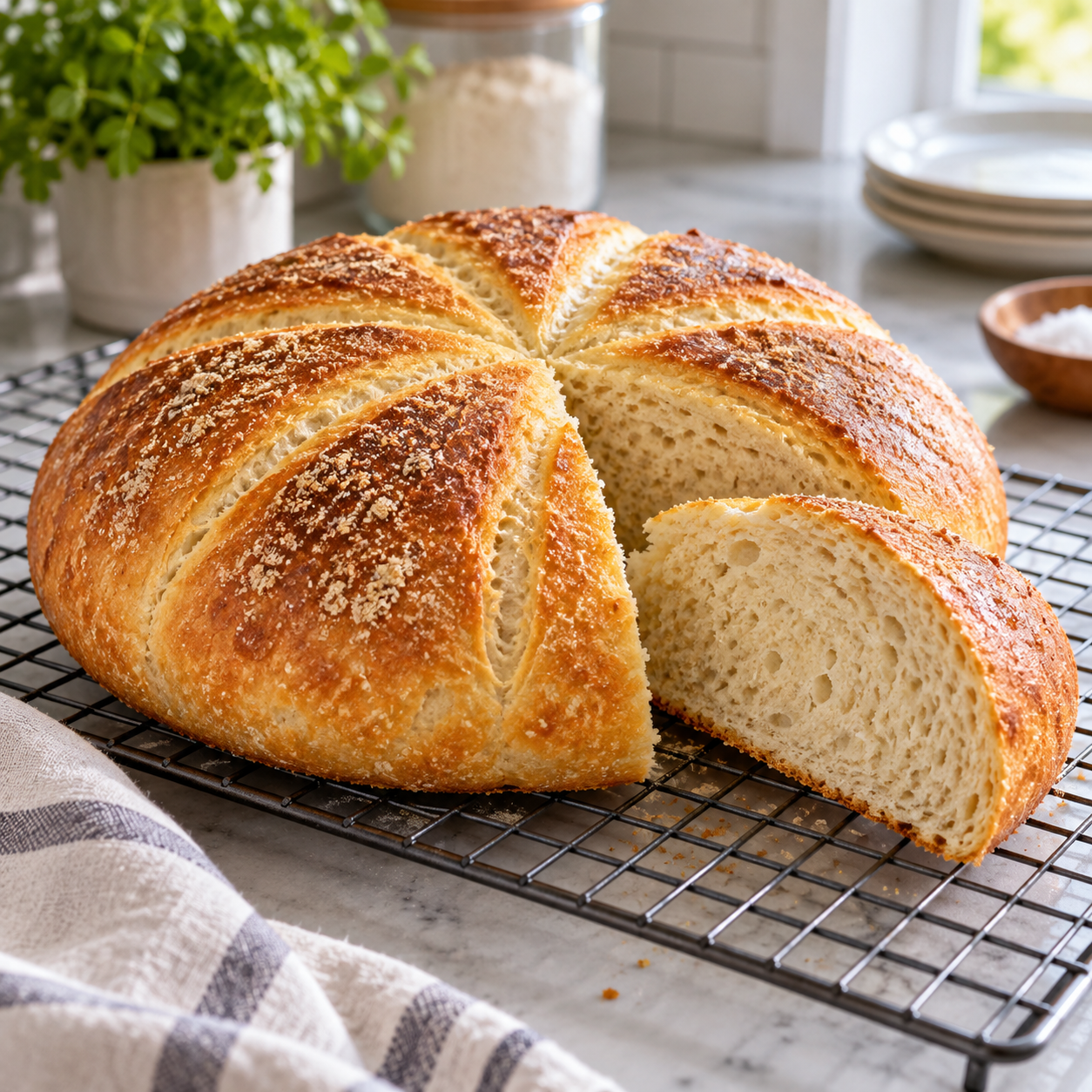
A round loaf divided into eight sections makes a memorable centrepiece without requiring specialist flour. The Archaeological Park of Pompeii’s carbonized breads preserve physical evidence from 79 CE. Their form inspires this loaf, but a surviving bread is not a written recipe and cannot supply our yeast quantity or oven temperature.
Cato’s section 74 separately gives a Roman kneaded-bread instruction using flour and water. It provides textual context for bread making, not evidence for Pompeii’s segmented shape or this yeast formula. This version deliberately combines ordinary strong white flour, wholemeal flour and commercial instant yeast for a manageable home rise.
The small wholemeal portion gives the crumb flavour while keeping the dough easy to knead. Add most of the water first, then judge whether the dough needs the remainder: flour varies. A shallow score marks the sections without separating them. We omit decorative stamping and string because neither is necessary for a practical loaf inspired by the visible shape.
Bake until the crust is firmly golden and the centre is cooked, then allow a full cooling period. Cutting hot bread compresses the crumb and makes a properly baked loaf seem gummy. The result should have a crisp outside and a springy, moderately close interior. It is an archaeological reconstruction in the limited sense of recreating a form with explicitly modern ingredients and measurements.
Everyday Segmented Wheat Loaf
Serves 8 · Preparation 20 min · Cooking 40 min · 100–140 minutes rising; 60 minutes cooling
A modern adaptation for home cooking. Times are approximate.
Ingredients
- 400 g strong white bread flour
- 100 g wholemeal wheat flour
- 7 g instant dry yeast
- 8 g (1¼ tsp) fine salt
- 330 ml lukewarm water
- 15 ml (1 tbsp) olive oil
Method
- Mix both flours, yeast and salt. Add 310 ml water and oil; mix to a soft dough, adding the remaining water if dry.
- Knead on a lightly floured surface for 8–10 minutes until smooth and elastic. Cover and rise 60–90 minutes until roughly doubled.
- Shape into a tight round, place on a lined tray and cover. Rise 40–50 minutes until puffy.
- Heat oven to 220°C/425°F. Score four crossing shallow lines to mark eight wedges. Bake 15 minutes, lower to 200°C/400°F and bake 20–25 minutes more.
- The crust should be deep golden and the centre about 94–96°C/201–205°F. Cool on a rack for 60 minutes before slicing.
Substitutions and adjustments
- All strong white flour works; begin with 310 ml water.
- Use 7 g active dry yeast according to its packet instructions.
Historical choices: The segmented form is inspired by preserved Roman bread. Commercial yeast and the entire measured formula are modern reconstruction choices.
Troubleshooting: Dense crumb: allow the dough to become visibly puffy rather than relying only on the clock. Check that yeast is within date.
Storage and reheating: Keep wrapped at room temperature for 2 days, or freeze slices up to 2 months. Toast from frozen.
Kitchen note: Bake flour fully; do not taste raw dough.
Sources and further reading
- Pompeii Commitment: Carbonized Breads. Archaeological Park inventory of carbonized cereal breads dated 79 CE; evidence is object form, not a measured formula.
- Cato, On Agriculture 74: kneaded bread. Inspected primary bread instruction provides Roman flour-water kneading context. It does not prove segmented form, commercial yeast or this modern formula.
Browse Ancient Recipes for Modern Kitchens · More creative work at Incoprea


Comments
Post a Comment